Peter Sagan: the showman who became a once-in-a-generation winner
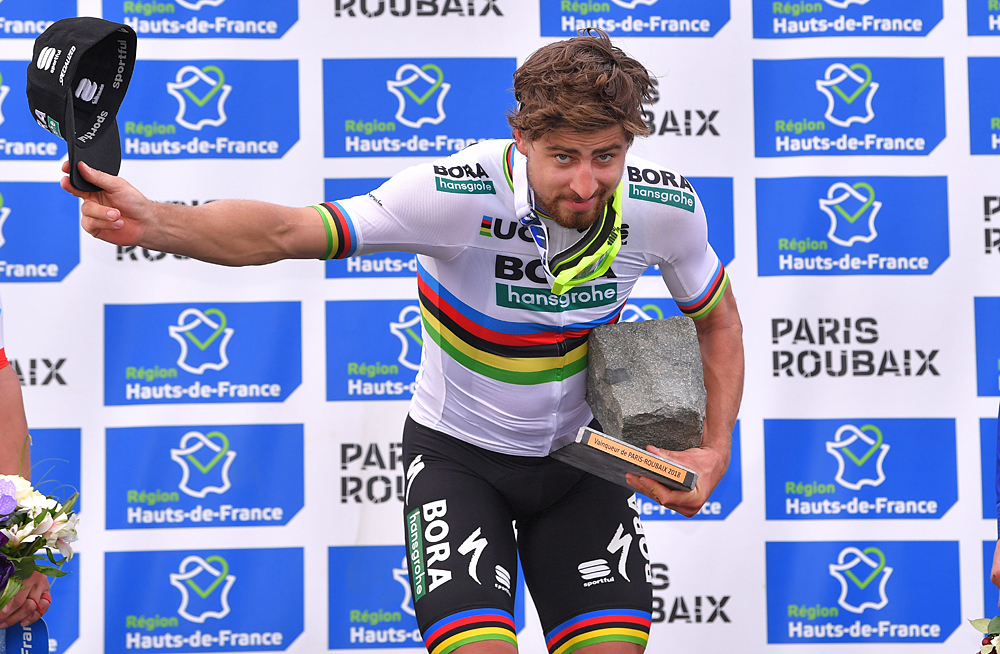
There are riders who win a lot, and riders who change what “winning” looks like. Peter Sagan did both. Part sprinter, part puncheur, part Classics hardman, and 100% entertainer, the Slovak superstar brought a new swagger to pro cycling in the 2010s—then backed it up with results that belong in the all-time conversation.
Born on 26 January 1990 in Žilina (then Czechoslovakia, now Slovakia), Sagan built a career defined by three pillars: unmatched consistency, rare versatility, and a finishing kick that survived terrain most sprinters fear. (Wikipedia)
The numbers that define Sagan’s career
Depending on how you count eras, categories, and databases, big winners can have slightly different totals across sources. ProCyclingStats lists 121 career victories for Sagan in its wins database. (ProCyclingStats)
But his “headline stats” are even more striking:
- 3× UCI Road World Champion (Men’s Road Race): 2015, 2016, 2017 (Wikipedia)
- 7× Tour de France Points Classification (Green Jersey): 2012–2016, 2018, 2019 (Wikipedia)
- 12 Tour de France stage wins (Wikipedia)
- Monument wins: Tour of Flanders (2016) and Paris–Roubaix (2018) (Wikipedia)
That combination—rainbow jerseys, green jerseys, Grand Tour stages, and Monument wins—puts him in a very small historical club.
The seven Green Jerseys: Sagan’s Tour de France era
If you want to explain Sagan to someone who doesn’t follow cycling closely, start with this:
He won the Tour de France Green Jersey seven times—a record-setting level of dominance in the modern points competition. (Wikipedia)
The green jersey isn’t just about pure bunch sprints. It rewards:
- sprint speed,
- positioning,
- day-to-day consistency,
- survival over climbs,
- and tactical aggression at intermediate sprints.
Sagan had the full toolkit. He could win flat stages, punchy uphill finishes, chaotic reduced-group sprints, and still rack up points even on days he didn’t win—because he was always near the front.
His Tour stage wins reflect that versatility: not just one sprint formula repeated 12 times, but a mix of stage types across multiple Tours. (Wikipedia)
And in 2016, he added another stamp on his Tour legacy with the Combativity award, underlining the part fans loved most: Sagan didn’t just race to survive—he raced to animate the race. (Wikipedia)
Triple rainbow: the 2015–2017 World Championship trilogy
World Championships are notoriously difficult to win because they’re raced once a year, with national teams, unpredictable tactics, and routes that vary wildly. Winning once is huge.
Sagan won three in a row: 2015, 2016, 2017. (Wikipedia)
This wasn’t a case of a single “perfect course.” It was Sagan proving, year after year, that when the race got selective—but still required a fast finish—he was the man everyone feared.
The Classics king who could sprint
Sagan’s greatest trick was being “too fast for the hard men” and “too strong for the fast men.”
The Monument breakthrough: Tour of Flanders 2016
Winning the Ronde van Vlaanderen requires power on cobbles, repeated short climbs, ruthless positioning, and a finishing move at exactly the right time. Sagan won it in 2016, and it remains one of the signature results of his peak years. (Wikipedia)
The cobbled crown: Paris–Roubaix 2018
Roubaix is the race that breaks riders mentally and mechanically. In 2018, Sagan finally conquered the “Hell of the North,” adding the most iconic cobbled Classic to his palmarès. (Wikipedia)
A string of major one-day wins
Beyond the two Monuments, Sagan’s list of top-tier one-day wins is stacked, including:
- Gent–Wevelgem (2013, 2016, 2018) (Wikipedia)
- E3 Harelbeke (2014) (Wikipedia)
- Grand Prix Cycliste de Montréal (2013) and other WorldTour one-day success (Wikipedia)
These races aren’t “sprinter freebies.” They’re selective, chaotic, and often decided by riders who can handle repeated accelerations and still finish fast—classic Sagan territory.
Grand Tours beyond the Tour: Giro & Vuelta wins
Sagan’s legend is Tour-heavy, but he also delivered in the other Grand Tours:
- Giro d’Italia: points classification (2021) and stage wins (including 2020 and 2021) (Wikipedia)
- Vuelta a España: multiple stage wins (including 2011 and 2015) (Wikipedia)
Across the three Grand Tours, the pattern repeats: he didn’t need one “perfect” scenario to win stages. If the finish demanded strength plus speed, he was a favourite.
The full résumé in one sentence
A lot of stars are specialists. Sagan was a category problem:
too explosive to drop, too strong to control, too fast to out-sprint.
And that’s why his career includes:
- rainbow jerseys (3),
- green jerseys (7),
- 12 Tour stages,
- major one-day dominance,
- and Monument wins in both Flanders and Roubaix. (Wikipedia)
Late-career chapters and the “what’s next” question
Sagan’s road career has had clear transitions in recent years, including a move toward other goals and a winding-down of his road calendar. Cyclingnews has covered developments around the closing stages of his road career and related announcements. (Cyclingnews)
Why Sagan’s legacy will last
Peter Sagan didn’t just win races—he made cycling feel louder, cooler, and more human. He turned intermediate sprints into events, made the rainbow jersey a weekly headline, and proved you can be a global superstar without being a pure GC rider.
And when you stack the results—121 wins (PCS), 3 Worlds, 7 Greens, Monuments, Grand Tour stages—it’s not just charisma. It’s historical greatness. (ProCyclingStats)

Related Posts
Five Tours, One Ghost: Pogačar’s Historic Summer and Cycling’s Ultimate Benchmark
Sean Kelly: The All-Terrain King of the 1980s